
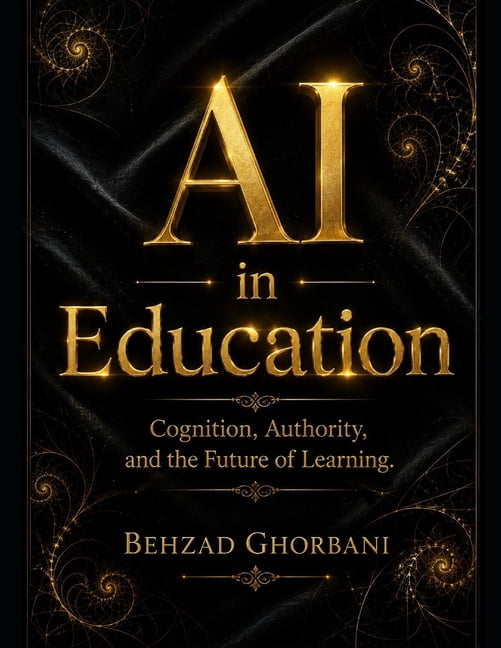
AI in Education: Cognition, Authority, and the Future of Learning, (Paperback)
Product details
| Management number | 238700793 | Release Date | 2026/07/11 | List Price | $10.80 | Model Number | 238700793 | ||
|---|---|---|---|---|---|---|---|---|---|
| Category | |||||||||
<p>Artificial intelligence is transforming education more rapidly than most institutions can fully comprehend. Essays, summaries, explanations, lesson plans, revision materials, and even sophisticated academic arguments can now be generated instantly through AI systems capable of remarkable linguistic fluency. Public discussion surrounding this transformation often swings between excitement and panic; some celebrate the arrival of unlimited informational access, while others fear the collapse of learning, expertise, and intellectual authenticity. Yet beneath these reactions lies a deeper question that extends far beyond technology itself: what actually happens to human cognition when thinking increasingly becomes externalised into intelligent systems?</p><p>This book begins not from abstract theory, but from direct classroom observation. Through a detailed anatomy and physiology teaching experiment conducted within contemporary educational environments, Behzad Ghorbani explores how students interact with AI-generated knowledge, how attention changes under digital conditions, and how modern learning increasingly shifts from internal cognitive reconstruction toward external retrieval and coordination. The classroom becomes a living laboratory where broader civilisational transformations reveal themselves in real time.</p><p>Across its chapters, the book examines the psychological, educational, and philosophical consequences of generative AI and algorithmic culture. It investigates the weakening of internal dialogue, passive interaction with generated content, attention fragmentation under social media environments, and the growing instability of traditional assessment systems. It explores how polished academic performance can conceal shallow understanding, how dependency on AI may gradually weaken reflective cognition, and why informational abundance does not automatically produce wisdom or intellectual depth.</p><p>At the centre of the book lies the concept of Recursive Intelligence; a framework proposing that intelligence is not merely informational possession or linguistic fluency, but an adaptive recursive process involving feedback, self-correction, reflection, contextual interpretation, and continuous interaction between internal cognition and external reality. Learning, within this perspective, becomes an evolving developmental system shaped through recursive cycles of questioning, critique, adaptation, uncertainty, and conceptual reconstruction.</p><p>The book argues that education is entering a historical transition comparable to the arrival of mass literacy or the printing press, but with even deeper implications for cognition itself. Teachers are no longer simply transmitters of information. Instead, they increasingly function as cognitive architects, mentors, evaluators of reasoning, and guardians of reflective thought within technologically saturated environments. Assessment systems must move beyond static outputs toward visible cognition, adaptive reasoning, oral defence, and longitudinal developmental observation. Classrooms increasingly become recursive human-machine ecosystems where AI participates not as replacement for thought, but as part of evolving educational interaction.</p><p>At the same time, the work defends the continuing importance of embodied learning, practical interpretation, deep reading, prolonged inquiry, and human mentorship. It argues that genuine understanding still depends upon struggle, reflection, uncertainty tolerance, conceptual integration, and lived engagement with reality. Artificial fluency alone cannot replace the developmental processes through which human intelligence matures.</p><p></p><p></p>
- AI in Education: Cognition, Authority, and the Future of Learning, (Paperback)
- Author: Behzad Ghorbani
- ISBN: 9798197364043
- Format: Paperback
- Publication Date: 2026-05-17
- Page Count: 552
| Book format | Paperback |
|---|---|
| Fiction/nonfiction | Non-Fiction |
| Genre | Textbooks |
| Publication date | May, 2026 |
| Pages | 552 |
| Subgenre | Schools |
| Series title | No Series |
| Number in series | 0 |
| Edition | 1 |
| Publisher | Amazon Digital Services LLC - Kdp |
| Language | English |
| Edu focus | General |
| Educational level | Higher |
| Is collectible | N |
| Recording time | 0 min |
| Retail packaging | Single Piece |
| Assembled product dimensions (l x w x h) | 8.50 x 1.12 x 11.00 in |
| Assembled product weight | 2.78 lb |
| Bisac subject heading | Education |
Bestseller ranking
All Books





Customers who viewed this product also viewed
Polishing Wheels


Correction of product information
If you notice any omissions or errors in the product information on this page, please use the correction request form below.
Correction Request Form